
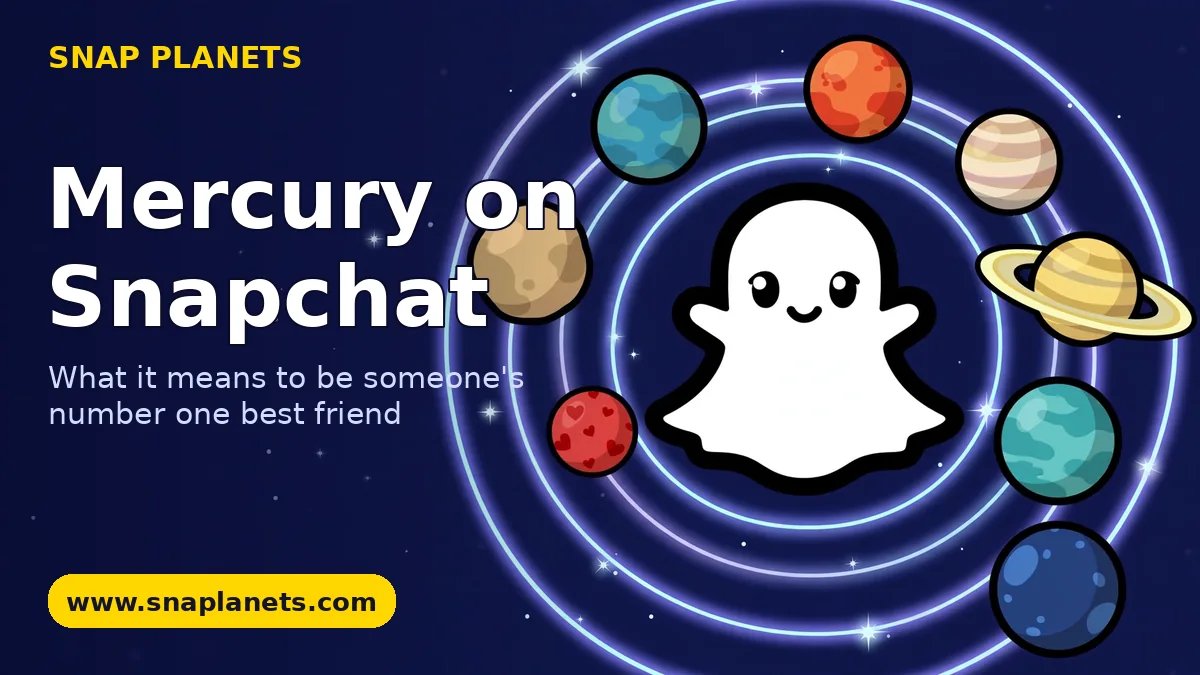
You open a friend’s profile on Snapchat and spot a small red planet with tiny red hearts around it. That little planet is Mercury on Snapchat, and it is the spot almost everyone wants. Mercury is the top position in the Friend Solar System. If you are someone’s Mercury, you are the person they Snap and chat with the most. You are their number one best friend on the app.
That sounds simple, but the planet badges confuse a lot of people. Some friends think Mercury is a reward. Others think it shows up for everyone. A few even worry when their planet changes overnight. This guide clears all of that up in plain words. You will learn what Mercury really means, how to check if you are someone’s Mercury, and what you can do if you want that top spot with a friend.
What Mercury on Snapchat Means
Mercury on Snapchat means you hold the number one spot in one person’s Friend Solar System. The Friend Solar System is a Snapchat Plus feature that turns your Best Friends list into a little space scene. You sit in the middle as the Sun. Your eight closest friends circle around you as planets. The friend you talk to the most sits closest to you, and that closest planet is Mercury.
In the real sky, Mercury is the planet nearest to the Sun. Snapchat copied that idea. The closer a planet is to the Sun, the closer that friend is to you on Snapchat. So Mercury is not just a cute icon. It is a rank. It says, out of everyone this person talks to on Snapchat, you come first.
Here is the part many people miss. Mercury is personal. Your Mercury is the friend you Snap and chat with the most. Your friend’s Mercury might be a totally different person. The app works it out for each person on their own, based on their own activity. Two friends can both feel close, yet only one of them may hold the Mercury spot in the other’s system.
It also helps to know what Mercury does not mean. It does not measure your real life friendship. It only counts what happens inside Snapchat. A friend you see every day at school but rarely Snap may sit far away as Neptune. A friend you Snap all day but have never met in person could be your Mercury. The planet follows your Snaps and chats, nothing else.
How the Friend Solar System Works
The Friend Solar System is part of Snapchat Plus, the paid version of Snapchat. Snapchat Support explains it like this: if you are a Snapchat Plus subscriber, you see a Best Friends badge with a gold ring around it on a friend’s Friendship Profile. Best Friends means that person is one of the eight friends you Snap and chat with the most. When you tap that badge, Snapchat shows you which planet you are in their Solar System.
Each planet stands for one position in the Best Friends list. The full order matches the real solar system:
One thing surprises new subscribers. The Solar System is off by default when you first join Snapchat Plus. You have to turn it on from the Snapchat Plus feature page in the app, and you can switch it off again at any time. If you pay for Plus and still see no planets, this toggle is the first thing to check.
Your Snapchat Best Friends list sits behind all of this. The planets are just a fun picture of that list. When your talking habits change, the list changes, and the planets move with it. Nothing about your rank is locked in forever.
What the Mercury Badge Looks Like
Mercury is easy to spot once you know what to look for. It is a small red planet, and it stands out because of the little red hearts floating around it. No other planet in the system looks quite like it. Venus sits in second place with a light tan colour and a mix of pink, blue and yellow hearts. Earth is blue and green with red hearts and a small moon. Mercury keeps things simple: red planet, red hearts, top spot.
The hearts matter. Only the first four planets, Mercury, Venus, Earth and Mars, carry hearts at all. The outer planets, Jupiter through Neptune, have stars instead and no hearts. So when you see hearts around a planet, you know that friend sits in the top half of the list. When you see red hearts on a red planet, you are looking at number one.
You will see the Mercury badge on a friend’s Friendship Profile, next to the Best Friends badge. If the badge has a gold ring around it, Snapchat is showing that you and this friend are Best Friends with each other. If there is no gold ring, the friendship rank runs one way only, which is more common than most people think.
How to Check If You Are Someone’s Mercury
Want to know where you stand with a specific friend? The check takes less than a minute, as long as you have Snapchat Plus. Follow these steps in order.
If you do not see a badge at all, one of a few things is going on. You may not be in that friend’s top eight friends yet. Your Snapchat Plus may have run out. The Solar System toggle may be off. Or the app may simply need an update. Check those basics first before you assume the worst about the friendship.
There is also a limit worth knowing. You can only see your own planet in a friend’s system. You cannot open a random person’s profile and browse their whole solar system. Each person sees their own view, and your full list of planets stays private to you. If you want to explore every planet and what each one means, our Snapchat planets guide on the home page walks through the whole system in order.
Does Mercury Mean You Are Best Friends Both Ways?
Not always. This is the question that starts the most arguments in group chats, so let us be clear. You can be someone’s Mercury without them being your Mercury. Each Solar System is built from one person’s habits. If Sara Snaps you twenty times a day but you mostly Snap your cousin, you may be Sara’s Mercury while your own Mercury is your cousin.
The gold ring is your clue. When the Best Friends badge on a profile has a gold ring, it means the feeling goes both ways at the Best Friends level. You are in their top eight, and they are in yours. When there is no gold ring, you are looking at a one way rank. That is normal. Most friendships on Snapchat are at least a little one sided when you count Snaps and chats.
Best Friends on Snapchat is its own thing too. Snapchat marks your top friends with emojis like the yellow heart for a number one best friend. The planet system builds on top of that same idea. Mercury and the yellow heart often point to the same person, but they are two different displays, so do not panic if they ever seem to disagree for a short time while the app catches up.
How to Become Someone’s Mercury on Snapchat
There is no secret button that makes you someone’s Mercury. Snapchat has never shared the exact maths behind the Best Friends list, and anyone who promises you a trick is guessing. What we do know, from how the feature is described, is that the rank follows how much you Snap and chat with that person. So the honest path to Mercury is simple: be the person they talk to most on the app.
These daily habits are what actually move your rank up:
A quick example makes this real. Say you want to become your friend Ahmed’s Mercury. Right now his Mercury is probably the friend he Snaps with morning and night. If you start sending Ahmed a few real Snaps a day: a photo of your lunch, a reply to his Story, a short chat about your day. Your name climbs his list bit by bit. It will not happen in an hour. Give it days of steady contact, and check the badge again.
One warning. Do not spam. Sending fifty blank Snaps in ten minutes feels fake, annoys your friend, and can hurt your Snap Score habits more than it helps your rank. The list rewards real, regular contact between two people. Slow and steady beats loud and desperate every time.
Why Your Mercury Planet Can Change
Planets move. That is normal, and it does not mean anything is broken. Your rank updates as your activity updates, so a quiet week can drop you from Mercury to Venus or Earth without any warning. The most common reasons look like this:
Read that last point again. Your planet lives in your friend’s system, so their behaviour matters as much as yours. You can do everything the same and still move, simply because your friend got closer to someone new. It stings a little, but it is just the app counting messages. It is not a report card on your friendship.
If your planet drops, the fix is the same as the way up. Go back to regular, friendly contact and let the list rebuild. Ranks that took weeks to build rarely come back in a day, so be patient with it.
Mercury vs the Other Planets at a Glance
Mercury gets the attention, but every planet in the top eight is still a Best Friend spot. Here is how Mercury compares with its nearest neighbours:
The gap between Mercury and Venus can be tiny. Sometimes one busy weekend of Snaps swaps the two spots. Try not to read deep meaning into a single swap. Look at where you sit over a few weeks instead. That longer view tells the true story of how much you two actually talk on the app.
Frequently Asked Questions
Conclusion
Being someone’s Mercury on Snapchat is a small thing, but it feels good. It means that, inside this one app, you are the person they reach for first: the lunch photos, the late night chats, the random funny faces. If you hold that red planet spot with a friend, enjoy it. And if your planet slips one day, do not take it to heart. Send a Snap, start a chat, and let the solar system sort itself out.